

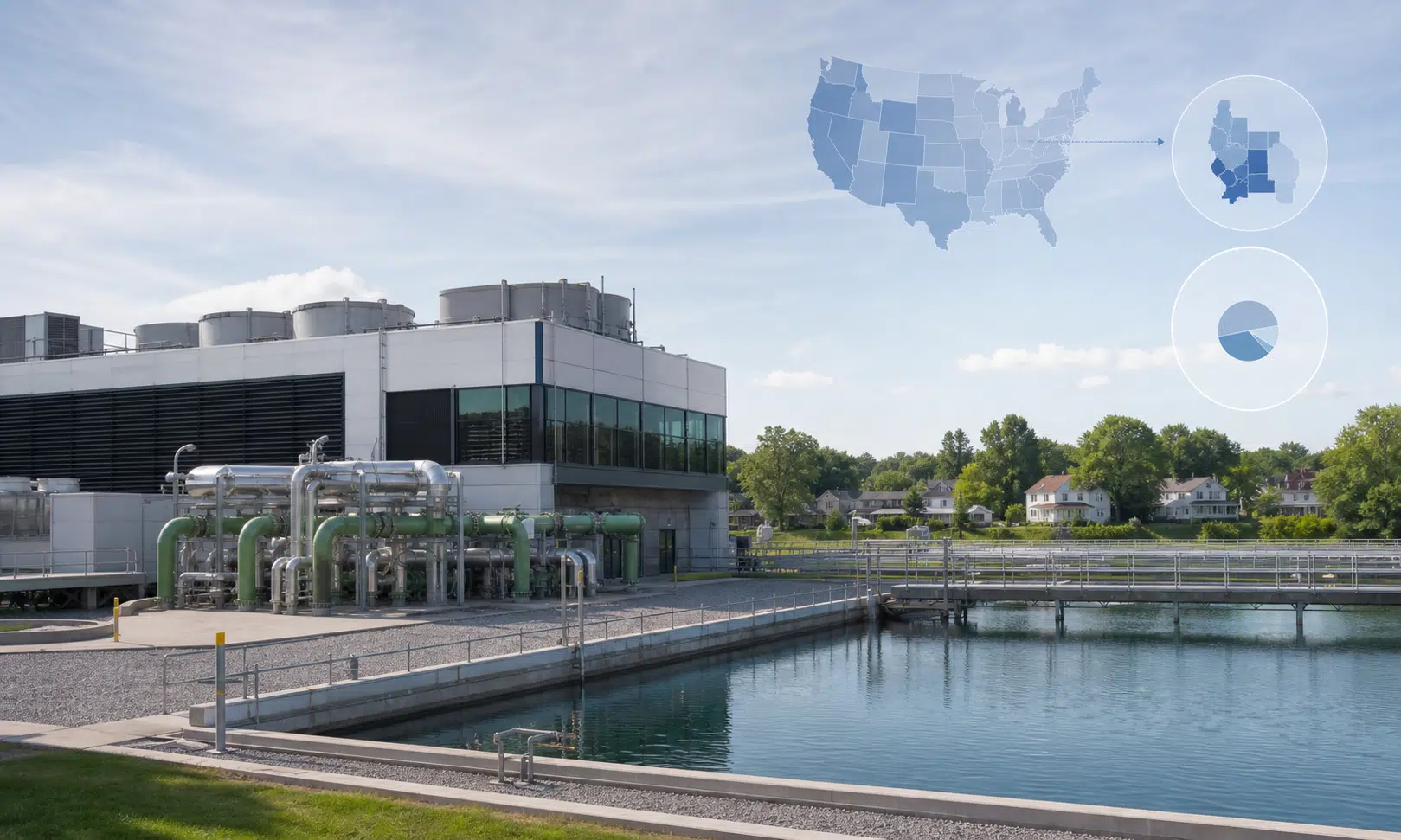

AI data center water use has become one of the easier environmental concerns to visualize. A server farm is abstract; a cooling system pulling water from a local supply is not. That makes the issue politically potent, especially in communities already worried about drought, utility costs, infrastructure, or industrial development.
The harder question is scale. Company disclosures and third-party estimates suggest that data centers are not close to dominating total water use when measured against national agriculture, landscaping, or other major categories. At the same time, that comparison can hide the problem residents actually feel: a single large facility can matter a lot when it is built in the wrong place, connected to a constrained water system, or approved without enough public scrutiny.
That distinction is the useful one. The broad numbers can make catastrophic claims about AI draining global water supplies look overstated. The local numbers can make community resistance look less like panic and more like a rational demand for better planning.
The Big Numbers Need Context
Amazon has said its data centers withdrew about 2.5 billion gallons of water globally in 2025. Because that figure comes from the company, it should be read as a corporate disclosure rather than an independently verified audit. Still, it gives a useful sense of the scale being discussed.
By itself, 2.5 billion gallons sounds enormous. Compared with overall U.S. water withdrawals, it is much smaller. The source material points to 117 trillion gallons of water withdrawn in the U.S. in 2015, along with much larger annual estimates for lawns, landscaping, almond orchards in California, and golf courses. Those comparison figures should be treated cautiously unless checked against their original datasets, but the basic point is clear enough: data centers are not the largest category in total water demand.
Other major cloud and social platforms have reported larger or smaller water withdrawals depending on year, footprint, and accounting method. The source material says Google data centers withdrew more than 6.1 billion gallons in 2024, while Microsoft and Meta were reported at about 2.75 billion gallons and 1.4 billion gallons, respectively. Those are useful directional figures, but they are still company-reported or source-dependent numbers, not a single standardized public ledger.
A 2021 academic estimate cited in the source placed total U.S. data center water consumption at about 163 billion gallons, including indirect water consumption tied to non-renewable power generation. That kind of estimate matters because data center water impact is not limited to water piped directly into a facility. Electricity generation can also carry water costs, depending on the power mix.
| Water-use category | Figure cited in source material | How to read it |
|---|---|---|
| Amazon data centers | About 2.5 billion gallons globally in 2025 | Company-reported disclosure |
| Google data centers | More than 6.1 billion gallons in 2024 | Reported company figure |
| Microsoft data centers | About 2.75 billion gallons in 2024 | Reported company figure |
| Meta data centers | About 1.4 billion gallons in 2024 | Reported company figure |
| All U.S. data centers | About 163 billion gallons in 2021 | Academic estimate including indirect consumption |
The buyer-aware takeaway for anyone evaluating cloud providers, AI services, or data-heavy infrastructure is not that water use is irrelevant. It is that aggregate water totals alone are a poor decision tool. Location, cooling design, power sourcing, reporting quality, and local scarcity matter more than a single headline number.
Why Local Impact Can Be Much Bigger Than the National Share
The global comparison can be true and still miss the point. A data center does not draw water from a national average. It draws from a particular water system, in a particular county or region, under local weather, infrastructure, and regulatory conditions.
That is why residents may reasonably worry even when national totals look small. The source material cites reporting that a Meta data center in Newton County, Georgia, used about 10 percent of the county’s water supply. Because that claim depends on outside reporting and local accounting, it should not be treated here as independently verified. But it illustrates the kind of local concentration that can change the practical meaning of data center water demand.
The same issue appears in northern Virginia, where the Interstate Commission on the Potomac River Basin has estimated that data centers account for a meaningful share of regional water consumption, with the potential for a much higher share by 2050 if growth continues. Those projections depend on assumptions about future construction, cooling systems, and water-management policy, so they are not guarantees. They are warning signals.
For communities, the most important questions are practical:
- Will the facility use evaporative cooling, air cooling, recycled water, or another approach?
- How much water will be withdrawn during hot or dry periods?
- Will the project compete with residential, agricultural, or industrial demand?
- Who pays for upgrades to water pipes, treatment systems, and related infrastructure?
- What happens if future expansion exceeds the original public estimates?
Those questions matter most in already water-stressed areas. The source material cites reporting that a substantial share of planned and existing U.S. data centers are located in places rated as having high or extremely high water scarcity by the World Resources Institute. That specific percentage should be treated as report-dependent, but the underlying planning concern is straightforward: building water-intensive infrastructure in dry or stressed regions raises the stakes.
Company Efficiency Claims Deserve Scrutiny
Large technology companies know that water use has become a reputational and permitting issue. As a result, they increasingly frame their data center strategies around efficiency, stewardship, replenishment, and local investment.
Amazon says it has allowed some data centers to run hotter to reduce cooling water demand, and says it uses less water per kilowatt-hour than other major data center providers. Because that comparison comes from Amazon, it should be read as a company claim unless independently audited. Still, the strategy itself is plausible: higher operating temperatures, more efficient cooling design, and better workload management can reduce water use in some facilities.
Amazon also says it is funding water projects expected to return billions of gallons annually for local communities. Google has made similar water-stewardship claims, including projects it says are expected to replenish billions of gallons annually by 2030. Those programs may matter, but they are not a substitute for clear facility-level reporting. A replenishment project in one watershed does not automatically erase stress in another.
For buyers comparing cloud or AI infrastructure vendors, the useful questions are narrower than the marketing language:
- Does the provider publish facility-level or region-level water metrics?
- Are withdrawals, consumption, and replenishment reported separately?
- Does the provider explain whether cooling water comes from potable, recycled, reclaimed, or non-potable sources?
- Are water figures audited or only self-reported?
- Does the provider disclose water risk by region, not just global totals?
A company can be more efficient than its peers and still create local pressure if it builds in a constrained area. Conversely, a high-compute facility may be easier to justify if it uses low-water cooling, operates where water is less scarce, and contributes transparently to local infrastructure.
The Real Debate Is About Siting and Trust
The source material also points to a broader political shift: communities are increasingly challenging data center projects before they are approved. Some objections center on water. Others involve electricity demand, noise, tax incentives, land use, public health, and whether local officials are moving faster than residents can evaluate the tradeoffs.
That resistance should not be reduced to a misunderstanding of technology. Data centers can bring tax revenue and local investment, and some communities may decide the tradeoff is worth it. The source material cites examples where data center development has been tied to major public revenue benefits. But those benefits do not answer every concern, especially when residents believe environmental review or public consultation is incomplete.
The sharpest version of the issue is not whether AI infrastructure should exist. It is whether the costs and benefits are being measured in the same place. A national company may count cloud revenue, AI capacity, and global efficiency gains. A town may count road changes, utility pressure, aquifer stress, noise complaints, and the risk that promised benefits do not reach the households closest to the facility.
That gap is why water has become such a powerful symbol. It is measurable, local, and easy to connect to daily life. Even when the national numbers suggest that data centers are a small part of total water use, the local permitting question remains: small compared with what, and small for whom?
What the Numbers Actually Support
The safest conclusion is a balanced one. AI data centers do not appear to be on track to consume anything close to the world’s water supply, and broad comparisons with national water withdrawals can help deflate exaggerated claims. But that does not make the issue trivial.
Water use becomes serious when facilities are clustered, when they depend on scarce local supplies, when they grow faster than infrastructure planning, or when companies rely on broad sustainability claims instead of detailed public reporting. The difference between a manageable project and a damaging one may come down to site selection, cooling technology, water sourcing, and enforceable local agreements.
For cloud buyers and enterprise teams, that means water use belongs in vendor due diligence, especially for AI workloads that may expand quickly. For residents and local officials, it means the right demand is not a blanket yes or no. It is a clear accounting of water withdrawals, seasonal risk, infrastructure cost, public benefit, and what happens if projected demand rises.
The phrase “drop in the bucket” may be directionally fair at global scale. It is much less useful at the county line. The more precise view is this: AI data center water use is probably not a global water catastrophe, but it can still be a local planning failure if companies and officials treat averages as answers.